

Written by Evelyn Mytka, Contributing Writer
Your customers have questions.
Every day, they’re searching online for answers, comparing businesses, and deciding who they can trust.
A blog helps your business become part of that conversation.
By creating helpful content that answers common questions, you can improve your visibility in search results, build trust with potential customers, and give people more reasons to visit your website.
Whether you’re writing your first blog or looking to improve your existing content, a few simple best practices can help you create articles that continue working for your business long after they’re published.
Why blogs still matter
Think about the last time you searched online for an answer.
Maybe you wanted to know:
- How much does a new roof cost?
- What’s the difference between bookkeeping and accounting?
- How do I choose the right wedding photographer?
- Why is my dog scratching so much?
Chances are that you clicked on a blog.
Every day, millions of people search for answers before making a purchase. If your business has already answered those questions, your website has an opportunity to appear in the search results.
Search engines and AI tools both favour content that demonstrates real experience and provides helpful, trustworthy information. Sharing your own knowledge and practical examples makes your content more valuable than generic articles.
Without helpful content, search engines have fewer reasons to recommend your website to someone who has never heard of your business.
That’s why blogging isn’t simply about publishing articles. It’s about helping future customers find you.
What blogging does for your business
A good blog can help you:
- Increase traffic to your website
- Build trust before someone contacts you
- Demonstrate your knowledge and experience
- Improve your visibility in search engines
- Answer common customer questions
- Support your social media and email marketing
- Keep visitors on your website longer
- Generate leads over time
Unlike paid advertising, which usually stops working when you stop paying for it, a helpful blog can continue attracting visitors long after it’s published.
Start with your customers, not keywords
Many business owners think they need special search engine optimization (SEO) tools or marketing software before writing a blog.
You don’t.
Start by thinking about the conversations you have every day.
Ask yourself:
- What questions do customers ask before buying?
- What misconceptions do people have?
- What mistakes do you see people make?
- What do you wish every customer knew before contacting you?
- What products or services need more explanation?
If you answer those questions honestly, you’re already creating valuable content.
A helpful blog is often just an extension of a conversation you’ve had dozens of times.
Not sure what your customers are searching for? Market research can help uncover the questions, challenges and topics your customers care about most. Business Link Alberta offers free market research services to help Alberta entrepreneurs better understand their target audience, making it easier to create blog content that answers real customer questions.
Think like your customer
Instead of writing about what you want to say, think about what someone is searching for.
For example, which title would you click?
Our Spring Services Are Here or Five Things to Know Before Hiring a Landscaper
The second title immediately tells readers they’ll learn something useful.
When choosing blog topics, imagine the exact words someone might type into a search engine. The closer your blog matches the questions people are asking, the more likely they are to find it.
Write for people first
Search engine optimization (SEO) is important, but your readers always come first.
Avoid writing awkward sentences simply to include keywords.
Instead:
- Write naturally.
- Use plain language.
- Explain industry terms.
- Answer the question completely.
Helpful content keeps people reading, and that’s good for both your audience and your search performance.
Make your blog easy to scan
Most people don’t read every word on a webpage.
They skim until they find the information they’re looking for.
Help your readers by using:
- Clear headings
- Short paragraphs
- Bullet points
- Numbered lists
- Images where appropriate
The easier your content is to read, the more likely people are to stay on the page.
Focus on one topic
One of the biggest blogging mistakes is trying to answer every possible question in a single article.
Instead, focus each blog on one main topic.
A blog called How to Prepare Your Small Business for Tax Season shouldn’t suddenly switch to payroll software, bookkeeping applications and business loans.
Keeping your content focused makes it easier for readers and search engines to understand what the page is about.
AI can help you write, but it shouldn’t replace your voice
AI tools like ChatGPT and Claude can be helpful for brainstorming ideas, organizing your thoughts, improving grammar or overcoming writer’s block. They can also help you create outlines, suggest headlines, or identify topics your customers may be interested in.
However, the most valuable part of your blog is something AI can’t create on its own: your experience.
Your customers want to know what you’ve learned, the challenges you’ve helped people overcome, and the practical advice you can offer. Those real-world insights help build trust and make your content more useful.
If you use AI, think of it as a writing assistant rather than the author. Review everything carefully to make sure it’s accurate, reflects your business, and sounds like you.
The best blogs combine your knowledge with AI’s ability to help you write more efficiently.
Keep quality higher than quantity
You don’t need to publish every week. One useful article each month is often more valuable than four rushed posts.
Before publishing, ask yourself: Would someone genuinely find this helpful?
If the answer is yes, you’re on the right track.
Don’t forget your call to action
Once someone finishes reading your blog, what should they do next?
You might encourage readers to:
- Contact your business
- Book a service
- Download a resource
- Read another related article
- Subscribe to your newsletter
Every blog should guide readers toward another step.
One blog can become weeks of content
A single blog can support your marketing long after it’s published.
You can turn it into:
- Several social media posts
- Newsletter content
- Short videos
- Frequently asked questions
- Infographics
- Website updates
- Talking points for presentations or webinars
Repurposing your content helps you get more value from the time you’ve already invested.
Update older blogs
Your website isn’t static, and your blogs shouldn’t be either.
Review older articles every year or two to:
- Refresh outdated information
- Add new examples
- Update statistics
- Improve readability
- Add links to newer content
Sometimes updating an existing blog is just as valuable as writing a new one.
Common blogging mistakes
Avoid these common pitfalls:
- Writing only about company news
- Making every blog sound like an advertisement
- Choosing clever titles instead of clear ones
- Publishing without sharing the article afterward
- Ignoring spelling and grammar
- Forgetting to link to other pages on your website
- Giving up after writing only one or two blogs
Blogging is a long-term strategy. Results often build gradually as your library of content grows.
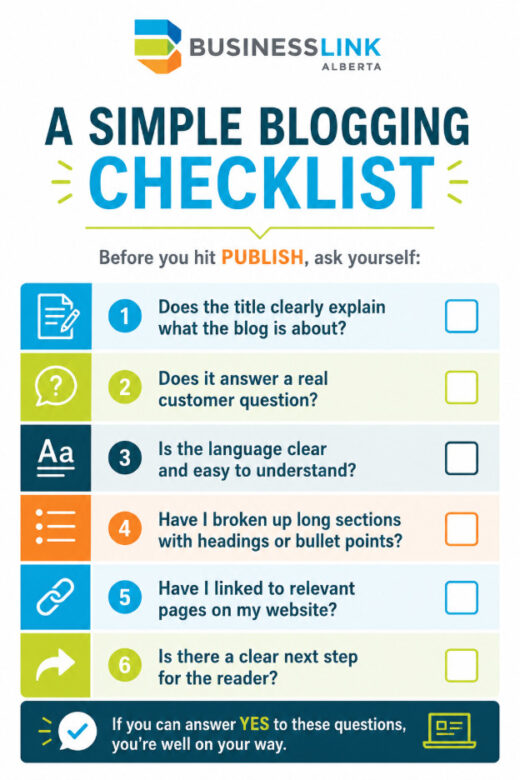
Start with what you already know
One of the biggest reasons entrepreneurs put off blogging is because they think they need to be professional writers.
You don’t.
You simply need to know your customers.
Think about the conversations you’ve had this week. Chances are, there’s a blog hiding in one of them.
The more helpful information you share, the more opportunities people have to discover your business, learn from your experience, and build trust before they ever reach out.
Blogging isn’t about filling your website with words. It’s about creating helpful content that works for your business long after you’ve published it.
If you’d like support developing your marketing strategy, Business Link Alberta offers free one-to-one support, webinars and resources to help Alberta entrepreneurs market and grow their businesses with confidence.